What to remember
- Choose fixtures after mapping tasks and obstructions.
- Uniformity and glare control matter alongside total output.
- Hex, linear high-bay, and panel systems serve different ceilings and uses.
- Plan controls, switching, service access, and future equipment before installation.
Start with tasks, not fixture style
Parking, detailing, woodworking, storage, mechanical work, exercise, and display all need different light relationships. A single bright fixture can still leave cabinet fronts, worktops, vehicle sides, and corners in shadow.
Map where people stand, where doors travel, and where tall storage or a vehicle lift may be added. That plan becomes the basis for fixture type, spacing, zones, and controls.
- General circulation
- Vehicle-side visibility
- Workbench and cabinet task light
- Storage and overhead rack access
- Door, opener, lift, and service clearances
Hexagon LED systems
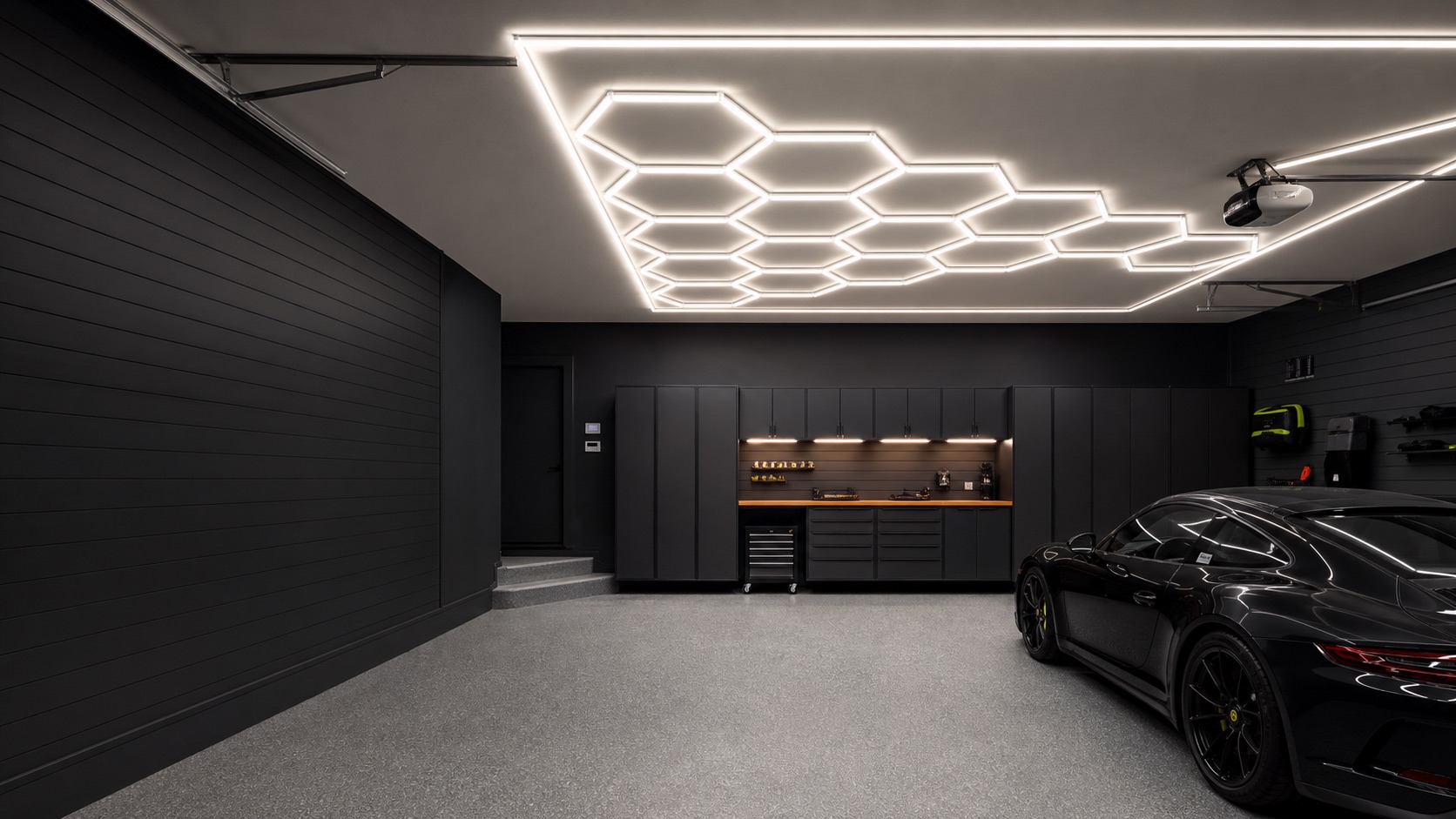
Hex grids create a strong architectural identity and broad luminous pattern. They are popular in detailing, collector, and display garages where the ceiling itself is part of the experience.
The grid must still be designed around ceiling dimensions, door travel, opener rails, structural attachment, power routing, glare, and future service access.
Linear high-bay systems
Linear high-bays are built for higher mounting conditions and work-oriented output. They can suit tall garages, lift bays, workshops, storage buildings, and light-commercial spaces.
Mounting height, beam distribution, spacing, glare, controls, and the actual work plane determine whether a high-output fixture performs well.
Low-profile LED panels
Panels create a quiet, low-profile ceiling appearance and can distribute light evenly in finished garages and compatible ceiling systems. They can also support offices or support rooms connected to a commercial garage.
Ceiling type, mounting method, driver access, dimming compatibility, surface temperature, and layout still require verification.
The performance checklist
A good lighting plan balances quantity with quality. Color rendering, color temperature, glare, flicker, zoning, dimming, sensors, switching, emergency needs, and maintenance access all affect the experience.
Photometric calculations may be appropriate for demanding projects, but even residential work benefits from documented fixture specifications and a measured layout.
- Ceiling and mounting conditions
- Fixture output and distribution
- Color quality and temperature
- Controls and compatible dimming
- Clearances and future equipment
- Commissioning and final aiming
Questions homeowners ask
Quick answers.
Are hex lights bright enough for garage work?+
They may be, but fixture specifications, grid size, mounting height, room reflectance, task location, and desired light level must be evaluated.
What color temperature is best?+
There is no universal answer. The finish palette, desired atmosphere, color-critical work, and fixture quality should be considered together.
Can new lights interfere with the garage door?+
Yes. Tracks, openers, high-lift conversions, door sections, and service access must be coordinated before the layout is finalized.
Join the discussion.
Ask a garage-planning question or share what you learned. Comments are reviewed before publication.
No published comments yet. Start the conversation.